

Flake is the most forgiving decorative system in this trade and the one installers most often price wrong. The gap between a partial broadcast and a full broadcast to rejection is not a small upcharge. It is a different quantity of material, a different day of labor, a different scrape, and a different finished floor, and if you bid them as if they are cousins you will eat the difference.
Here is how the two actually compare on the jobsite, plus the flake size question, the recoat sequence, and the edge work that decides whether a flake floor looks professional or homemade.
Partial broadcast: what you get and what it costs you
A partial broadcast, sometimes called an accent or a scatter broadcast, means you throw flake at a rate that covers some percentage of the wet base and deliberately leaves base color showing between the chips. Coverage ranges anywhere from light scatter up through most of the surface, and the base color is a design element rather than something to be buried.
On material, you are typically in the range of a quarter to a half pound of flake per square foot depending on how heavy you go, against a full broadcast which usually runs closer to a pound or more per square foot before you stop. That is a real difference across a three car garage. On labor, the broadcast itself goes faster, and more importantly the scrape afterward is dramatically lighter because there is far less loose flake standing proud of the surface.
What you give up is hiding power and texture. Base color showing through means slab color showing through wherever your base coat went thin, and partial broadcast floors show telegraphing from a rough or patched slab more readily than a full broadcast will. The surface also comes out closer to smooth, which reads elegant and gets slick when wet unless you add grit to the topcoat.
Partial is the right call on a floor with a decent slab, in a space where somebody chose the base color on purpose, and where the customer wants something that reads as a designed finish rather than a utility floor. It is not the budget version of full broadcast. Sell it as its own thing.
Full broadcast to rejection: what rejection actually means
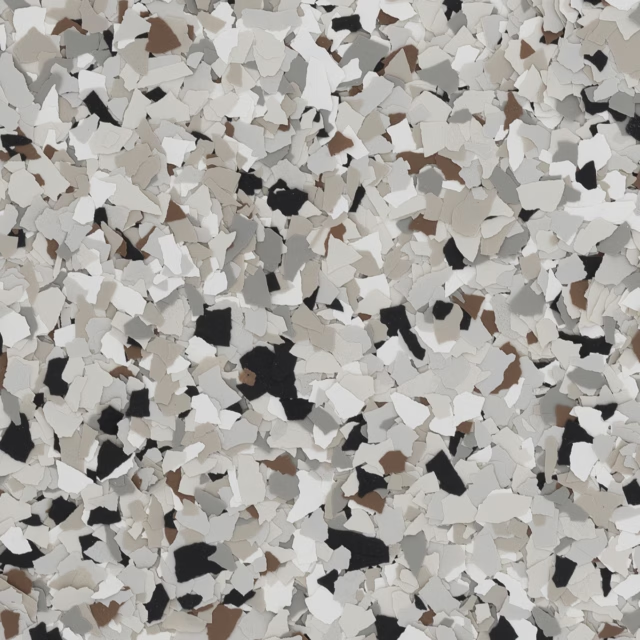
Broadcasting to rejection means you keep throwing flake into the wet base until the surface will not accept any more. Chips land on chips and bounce off. The base is completely buried, invisible, gone from the equation. When it stops taking material, you are done, and that is the honest definition of the term. Not “until it looks covered.”
Do not stop early on this. A floor broadcast to eighty five percent and called full is the worst outcome available, because the thin spots read as blotches once the topcoat goes on and there is no way to fix them without recoating the whole floor. Rejection is a binary. Either the surface refused more flake or it did not.
The trade you are making is material and labor. You will use two to four times the flake of a partial, and a meaningful percentage of that flake ends up on the ground as overspray you sweep up and throw away. Plan quantity with that waste built in rather than ordering exactly what the coverage rate says.
The scrape is the real cost. Every chip standing on edge has to come off before topcoat, and on a full broadcast that is a full day with a scraper on a big floor, followed by vacuuming, followed by more scraping where you missed. Installers who bid full broadcast at partial broadcast labor lose that day out of their own pocket every single time.
What you buy with it is hiding power that nothing else in the catalog matches. A full broadcast will bury a slab with patches, old adhesive shadows, color variation from previous repairs, spalled areas you filled. That is why it dominates garage work. It also gives you genuine texture underfoot, which is real slip resistance without additives, and a floor that hides dirt between cleanings better than any solid color. The systems and blends we stock for this sit on our flake page.
Flake size, and what each one does to the floor
Size changes the look more than color does, and it is the variable customers understand least, so it is on you to walk them through it.
- 1/16 inch. Reads almost as a solid color with texture rather than as flake at a normal viewing distance. Nearly no relief underfoot. Good where somebody wants a quartz-like appearance without a quartz budget or a quartz install, and good in spaces where a busy floor would compete with everything else in the room.
- 1/8 inch. The default for a reason. Visible chip, readable pattern, moderate texture, and it is the size most commercial and residential customers picture when they say flake floor. If a customer cannot decide, this is the one that disappoints the fewest people.
- 1/4 inch. Bold, distinctly visible chips, and noticeably more relief. It hides slab problems better than the smaller sizes because each chip covers more ground. It also needs more topcoat to bury the profile, which is a cost people forget when they upsize at the last minute.
- 1/2 inch and up to 1 inch. Statement territory. Large chips read almost like terrazzo at distance and create real texture you feel through a shoe. These sizes demand a heavier topcoat build and they will show every chip that did not lay flat. Beautiful on the right floor, punishing on a rushed one.
Mixed-size blends are worth knowing about. A blend running a small size as the bulk with a scattering of a larger chip gives you visual interest without the topcoat demands of going large across the whole floor. It is a good middle answer for a showroom that wants presence and a return-to-service schedule.
Scrape and recoat, done in the right order
The sequence after broadcast is where flake jobs are made or lost, and it is not complicated. It is just unforgiving about being rushed.
Let the base cure enough to hold the flake but do not let it get so hard the scrape becomes a fight. That window depends on the product and the shop temperature and it is one of the things worth asking about for the specific system you are running rather than working off a general rule.
Scrape the whole floor with a sharp blade held at a low angle. You are knocking down the chips standing on edge, not skinning the surface. Go over it in two directions, because chips lie down at an angle and a scraper coming from one direction will slide over some of them. Then vacuum, then run your hand across it. Your palm finds edges your eyes miss, and any edge you can feel is an edge that will telegraph through the topcoat.
Then topcoat, and this is where the failures happen. A full broadcast floor has enormous surface area, all those chip faces and edges, and it drinks material. A topcoat applied at the coverage rate printed on the can, which was calculated for a smooth surface, will not fill the profile on a full flake floor. What you get is a starved coat: chip edges poking through the film, a rough surface that catches dirt and will not clean, and a topcoat with no real thickness anywhere to resist wear. It fails early and it fails visibly.
The answer is two coats on a full broadcast, essentially always. The first coat wets out and fills the profile, the second builds the film that does the work. Budget material for both coats when you bid it. A partial broadcast has far less profile to fill and can often live on a single well-applied coat, which is another line in the honest comparison between the two. Scrapers, blades, spiked shoes and the rest of what this sequence needs are on the tooling and consumables page.
Edges and cove work, where the money is won or lost
Nobody inspects the middle of a flake floor. They look at the perimeter, the door threshold, and anywhere the floor meets a wall, and that is where amateur work announces itself.
Broadcasting into a corner is awkward because a hand throw naturally goes long. If you broadcast the field first and then try to fill in the perimeter, the perimeter chips land on base that has already started to set and they will not seat. Work the perimeter and corners while that base is genuinely wet, then bring the field into it.
Coved base is the upgrade that turns a good flake floor into a finished room, and it is worth learning if you do not do it yet. A cove carries the coating up the wall in a radius instead of stopping at a hard line, which eliminates the dirt trap at the wall joint and makes the whole installation read as one surface. Flake goes into cove work too, and the technique is different enough from floor broadcast that it is worth practicing on a scrap before doing it on somebody’s locker room. It is one of the things covered in our training academy, because it is far easier to be shown than to be told.
Terminations matter as much. A flake floor that dies at a doorway with a ragged chipped edge undoes the rest of the work. Tape a clean line, or run a proper transition strip, and finish the edge deliberately.
Matching a blend to the space you are actually in
The right blend is a function of the room, not of what looked good on the last job.
A residential garage is a hiding job. The slab has history, the lighting is usually poor, and the floor will see hot tires, dropped tools, and road salt in some regions. A full broadcast in a mid-size chip with a blend that carries some visual noise, meaning several tones rather than one color plus white, will hide dirt and hide the slab and stay looking clean between cleanings. Darker overall blends hide oil. Lighter blends brighten a dark garage but show everything.
A commercial showroom is a presentation job. The lighting is good, the floor is being looked at deliberately, and it usually needs to work with a brand palette. This is where partial broadcast earns its place, or a full broadcast in a tight blend with low contrast between the chips, which reads as a rich solid surface rather than a pattern. Coordinate with what is going on the walls before you order.
A locker room or a wash-down space is a safety and sanitation job first. Full broadcast for texture, a topcoat rated for the chemicals used in cleaning, cove base at every wall so there is no seam collecting water, and slip resistance you actually verified rather than assumed. Aesthetics come after those.
Order samples of anything you have not run. A blend on a screen is not a blend on a floor, and the difference is often significant enough to change which blend you would have picked. Ask us to put a handful of physical chips in an envelope before you commit a whole job to a color you have only seen rendered.
Five things crews call in about flake
Q. How much extra flake should I order for a full broadcast? More than the coverage rate suggests, because a real percentage of what you throw ends up on the floor as overspray and gets swept up. Broadcasting to rejection means the surface refuses material, and the material it refuses is waste. Running out mid-floor is far more expensive than having some left over, so order with margin.
Q. Can I use a partial broadcast to hide a bad slab? Not reliably. Partial leaves base color visible between the chips, so anywhere your base went thin over a patch or a stain, that history shows. If the slab is the problem, full broadcast is the tool. If the slab is clean and the customer wants the base color as part of the design, partial is the tool.
Q. Why is my flake floor rough after topcoat? Almost always a starved topcoat or an incomplete scrape, and often both. Full broadcast has a huge amount of surface profile and a single coat applied at smooth-surface coverage rates will not fill it, so chip edges stay proud. Scrape in two directions, check with your palm rather than your eyes, and plan two topcoat coats over a full broadcast.
Q. Is bigger flake more slip resistant? Somewhat, but it is not the right lever to pull for slip resistance. Larger chips create more relief, and full broadcast of any size creates more texture than partial. If slip resistance is a requirement rather than a preference, add a proper anti-slip aggregate to your topcoat and specify it, instead of relying on chip size to get you there.
Q. Do I need to scrape a partial broadcast? Yes, just less of it. Fewer chips are standing on edge because you threw less material, but the ones that are will telegraph through the topcoat exactly the same way. Run the blade, vacuum, check by hand. It is a much shorter job than a full broadcast scrape, which is part of why partial costs less to install.
Get the quantities right the first time
Running short of flake in the middle of a broadcast is the worst ten minutes in this trade, and running two pallets long is money sitting in your shop. Give us the square footage, the chip size, and whether you are going full or partial, and we will work the numbers with you rather than selling you the round-up. (209) 208-4656 reaches Chris. So does the contact page. He has poured enough of these floors to tell you when a job needs less than you thought, and he says so.