
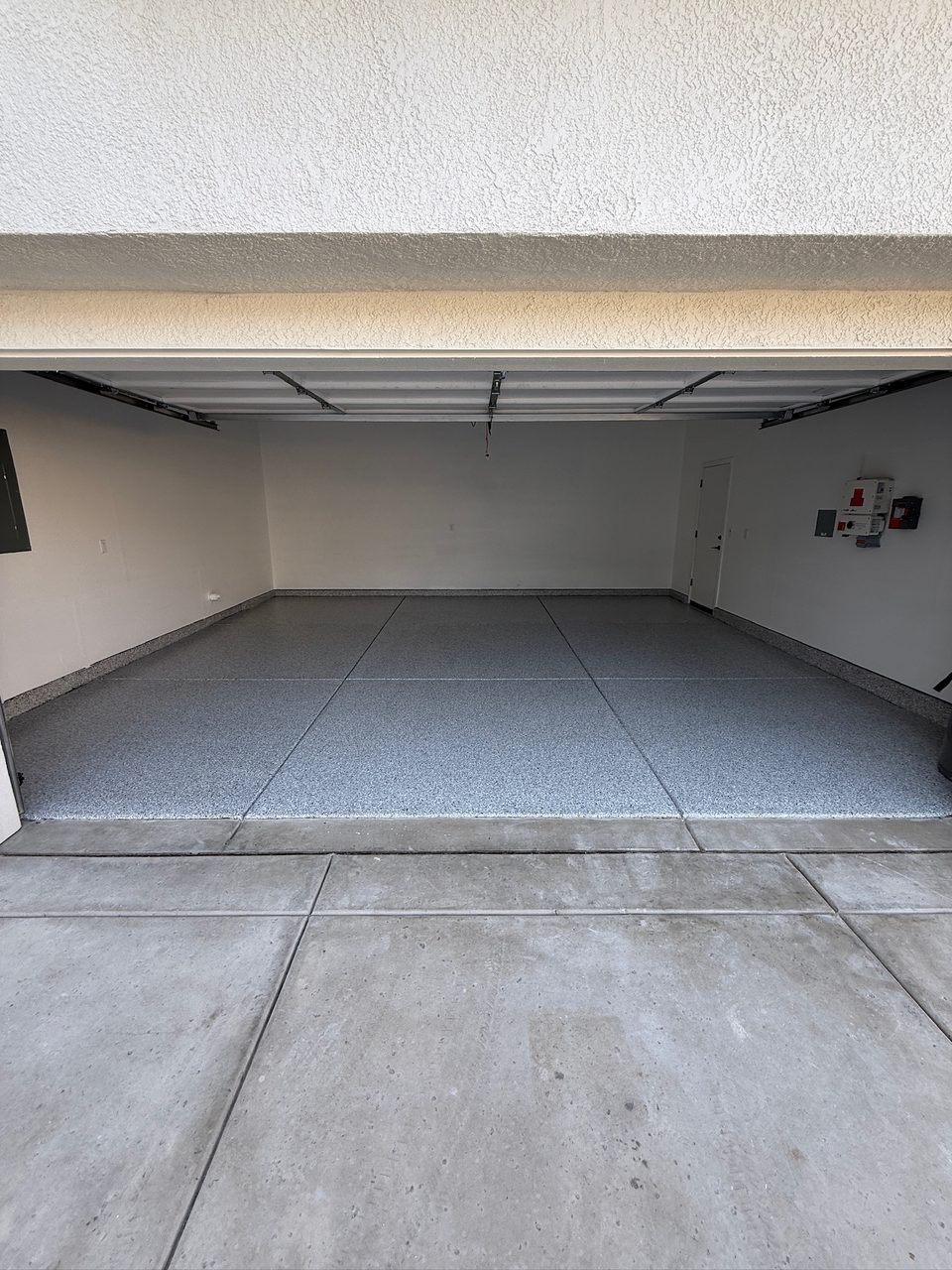
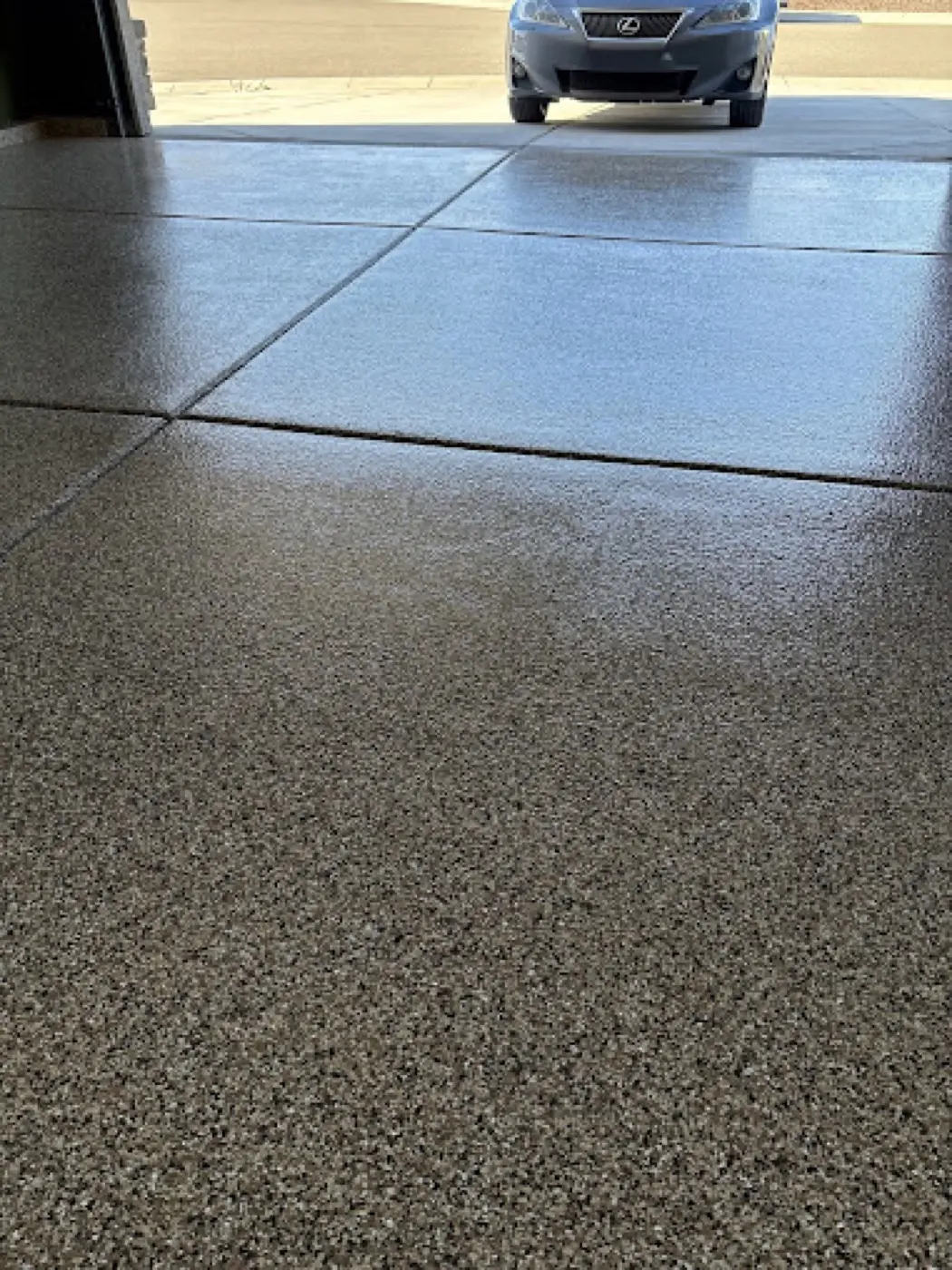
Lap marks are the flaw every owner finds. They show as stripes of heavier and lighter gloss, clearest at an angle from the garage door or under a work light at night, and once a fast topcoat has set there is no rolling them out. Polyaspartic gives a crew less time to rescue a missed edge than epoxy does. Crews working in Lodi can plan most of the problem away before the first kit is opened, with smaller batches and a room lit to show every miss.
Size the batch to the floor you can finish
The most common cause of lap marks is a batch too big for the crew to spread before it starts to set. When the back half of a kit goes down thicker than the front half, the edges stop blending.
Before the job, measure how much floor one person can squeegee and back roll with a practice batch, or ask the bench how that particular topcoat behaves. Then mix to that size, even when it means splitting the kit. Splitting demands accurate measuring, so use marked containers or a scale and keep the ratio exact.
Work the batches out against sections of floor. A two-car garage might be broken into strips across its width, one batch to a strip, with tape on the wall showing where each strip ends. On a warm slab the strips get narrower. The polyaspartic topcoats come with data sheets that describe working time, and that section should drive the math more than the size of the pail does.
Keep the wet edge wet
A lap mark is a place where fresh material was rolled over material that had already started to set. Every habit below exists to keep that from happening.
Pour a ribbon of topcoat and pull it out with a flat squeegee, with the roller following right behind. Always roll back into the wet material you just laid, overlapping into it, and never leave an edge sitting while the next batch gets mixed. End each section at a wall, a joint or a taped line, where a seam is expected.
Two people make this far easier than one. One mixes and pours while the other spreads and rolls, so fresh material lands in front of the roller before the edge behind it dulls. Keep the mixing station close to the work, so nobody walks to the far end of the driveway between batches.
If you have to stop, stop at a joint. A break in the middle of open floor is the hardest seam to hide, and on a fast topcoat it is usually still visible after a second coat.
Roller nap and cover choice
The data sheet names a nap length, and it pays to follow it exactly. A cover too thick holds extra material and lays down an uneven film. A cover too thin starves the floor and leaves dry streaks that look like laps even when the timing was right.
Use covers rated for the coating, with a shed-resistant core. A fiber left in a clear topcoat stays there for good. Before a cover touches the floor, wrap it in painter’s tape and peel it off to lift loose lint, then roll it out on a scrap of cardboard.
On a flake floor, the chip texture drinks topcoat unevenly, so a nap that suits a smooth floor may leave thin spots over a broadcast. The decorative flake systems carry a topcoat on the spec, so ask for the matching nap when you order.
Change covers once they start to drag or feel heavy with partly set material. A stiffening cover pulls lines through the fresh coat behind it. Plan on several covers per garage, and keep them bagged until they go on the frame.
Back rolling direction and the final pass
Once the squeegee has spread the coat, the roller evens out the film. The direction of those last passes decides how the floor reads from the doorway.
Roll the final pass in one direction across each section, usually square to the main light source or parallel to the long wall, and keep every section going the same way. Mixed directions catch light differently and read as patches even when the film thickness is even.
Keep the pressure light. Pushing hard squeezes material out of the nap and leaves ridges along the edges of the cover. Let the weight of the roller do the work, overlap each pass by about half the cover width, and lift off gently at the end of a stroke.
Walk backward toward the exit as you go, in spiked shoes, rolling out your own shoe marks. Plan the room so the last section ends at the door, with the roller finishing the threshold while nobody stands on it.
Light the room so misses show before the coat sets
A garage lit by one overhead fixture hides almost everything. Misses, thin spots and holidays only show when light hits the floor at a low angle.
Set a work light on the floor at one end of the room, aimed across the surface, so the wet coat reflects it as a sheet. Holidays show up as dull patches and laps show as bands. Move the light along with the work, or set a second one near the door.
Check each section right after rolling, while there is still time to feather in a thin spot with a lightly loaded roller. Once the edge has started to set, leave it alone, because working it again makes a bigger mark than the one you meant to fix.
After the floor cures, look again from the doorway with the garage door open and the sun low. That view is how the property owner will see the floor for years. If a lap still shows, the recoat steps on the data sheet are the fix, and they go faster on a floor that went down under good light the first time.
Topcoat questions we hear most
What causes lap marks in a polyaspartic topcoat?
Almost always fresh material rolled over an edge that had already started to set. Batches too big to spread in time, a mixing station far from the work, and pauses in open floor all lead there. Smaller batches, a second person pouring, and ending every section at a wall or joint keep the edge wet enough to blend.
Which roller nap should I use on a flake floor?
Start with the nap printed on the topcoat’s data sheet. Flake texture takes more material than a smooth floor, so a cover that is too short can leave thin spots over the chips. Use a shed-resistant cover rated for the coating, de-lint it with tape, and change it as soon as it starts to drag. Ask the bench when you order.
Can lap marks be fixed after the topcoat cures?
Usually, by lightly scuff sanding the cured topcoat, cleaning it, and rolling a thin second coat the way the data sheet directs for recoating. Rolling back into a setting edge only makes the mark worse, so leave it until the floor cures. Light the room from floor level for the second coat so the fix does not leave new laps.
A clean topcoat comes from the plan as much as from the hand on the roller. Before your next garage, send the slab size and the system and we will help size the batches, or talk to the owner at (209) 208-4656 about the nap and the working time.